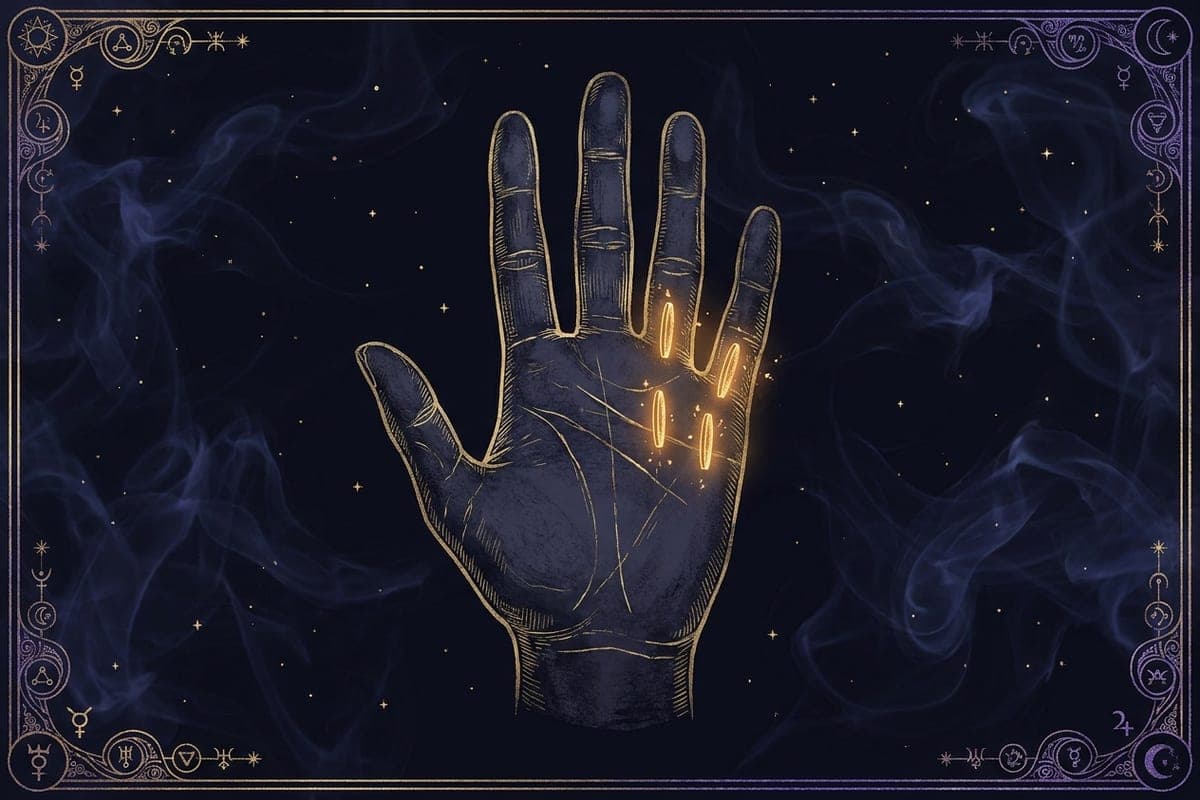
Ask ten palmists to point at the money line and you will get several different answers, because the hand has no such line. What it has is a cluster of small marks that the tradition reads together, and a very old idea about what fortune is.
THE MARKS THAT GET CALLED MONEY LINES
The first is the line of Sun — sometimes the line of Apollo — running up toward the ring finger. It is read as recognition: work that is seen, and paid for being seen. The second is the line of Mercury, under the little finger, read as trade, persuasion and the ability to turn talk into an arrangement.
The third is not a line at all but the small crossing marks below the fingers, read as chances taken. Where the Sun and Mercury lines are both present and clear, and the fate line runs deep beneath them, palmists read a hand that has made a living out of what it is actually good at. That combination — not any single crease — is what people mean when they say money line.
WHAT THE TRADITION READS AS FORTUNE
Older palmistry is less interested in the amount than in the relationship. A strong Mercury line with a weak Sun line is read as someone who earns well and is never quite credited. The reverse is read as someone widely admired and chronically underpaid, which is a fate common enough to have its own mark.
The mounts matter as much as the lines. A full mount beneath the ring finger is read as a taste for beautiful things; beneath the little finger, as a quick tongue and a quicker calculation. Read together they are less a forecast than a description of how a particular person is likely to get paid.
THE HONEST PART
No line in a hand knows what is in an account. Palmistry cannot forecast a salary, a windfall, or a market, and a reading that promises one has crossed from entertainment into something you should walk away from.
What a reading can do is put words to a pattern the person already half-knows: that they are better at making things than selling them, that they have twice built something and twice handed it to somebody else to run. The pleasure is in the recognition, not the prediction.
LOOKING AT YOUR OWN
Tilt the palm until the light rakes across it — the small lines beneath the fingers are faint and only appear at an angle. Count what is actually there rather than what you hoped to find. Most hands have one of the two lines strongly and the other barely, and that asymmetry is the reading.
Faterya reads the whole hand at once: the nine lines, the mounts beneath the fingers, and what your birth date settles about the element and the numbers you were born under. One photograph, a minute, and the lines are read aloud.
Palmistry is a way of talking about a life, not a forecast of one. Nothing here is medical, legal or financial advice.