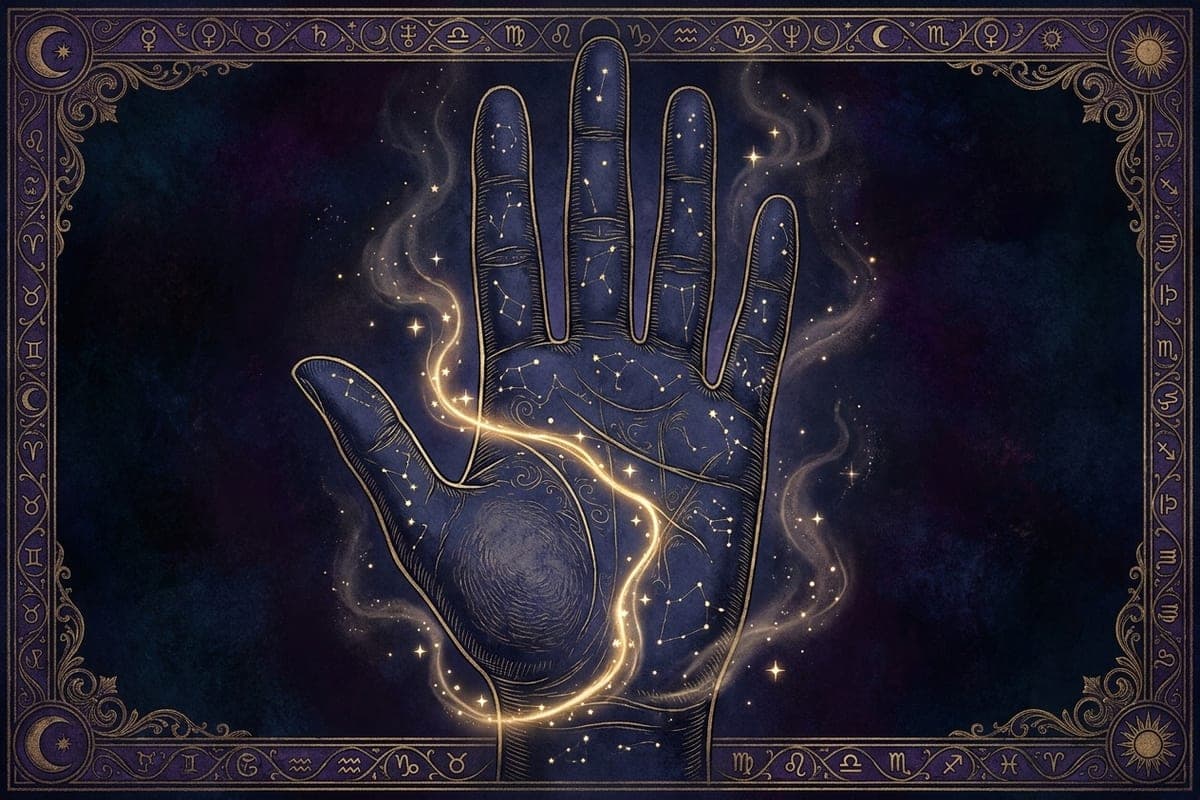
It sweeps around the base of the thumb like a harbour wall, and almost everyone who looks at their own palm looks at this one first, with the wrong question in mind.
THE ONE THING EVERYBODY GETS WRONG
A short life line does not mean a short life. No serious palmist has read it that way in a very long time, and no reading here will. What the line is read for is vitality — the weather inside a person, their constitution, the energy they have to spend and how they spend it.
It is worth saying plainly, because the fear is common and it spoils the fun: nothing in a hand predicts illness or death, and anyone who tells you otherwise is selling something worse than entertainment.
THE SHAPE OF THE CURVE
A wide arc, swinging far out into the palm, is read as an open constitution: physical, warm, generous with energy, quick to give it away. A close arc, hugging the thumb, is read as a life lived nearer the centre of itself — careful with its reserves, harder to exhaust because it does not spend at that rate.
The arc is also read as appetite for the world. Wide is read as the person who books the flight; close, as the person who keeps the house warm for their return. Neither is the better hand. Most people are read somewhere between the two, and their arc changes over a life more visibly than any other line.
BREAKS, LADDERS AND SISTER LINES
A break in the life line is read as an interruption — a season of illness long past, a move, an upheaval that took something out of the body as well as the day. Where the line picks up cleanly on the inside of the break, the tradition reads a recovery that changed the person's course rather than merely delaying it.
Fine lines crossing it like the rungs of a ladder are read as a period of strain: the years of carrying more than one person should. A second faint line running inside it — the sister line, or line of Mars — is read as reinforcement, and palmists like finding it. It is the mark of somebody who has been held up, by their own constitution or by other people.
WHERE IT STARTS AND WHERE IT ENDS
High between thumb and index finger, it is read as ambition present from the start. Lower, closer to the thumb, as a nature that took its time. Where it ends — sweeping to the wrist, or turning out toward the outer edge of the palm — is read as where a life settles: at home, or somewhere far from where it began.
Read the two hands together. The working hand shows what has been made of the constitution; the other, what was given at the start. The distance between them is the interesting part, and it is the part a photograph of one hand alone cannot show you.
FOR WONDER, NOT FOR FACT
Palmistry is a very old way of talking about a person, and its usefulness lies in the talking, not in the prophecy. A line is a good excuse to say something true about someone that would sound absurd said plainly.
If you would like yours read — the life line, the head, the heart and the rest of the nine — Faterya does it from one photograph, and never predicts an illness or a date. It is entertainment, and it says so.
Palmistry is a way of talking about a life, not a forecast of one. Nothing here is medical, legal or financial advice.