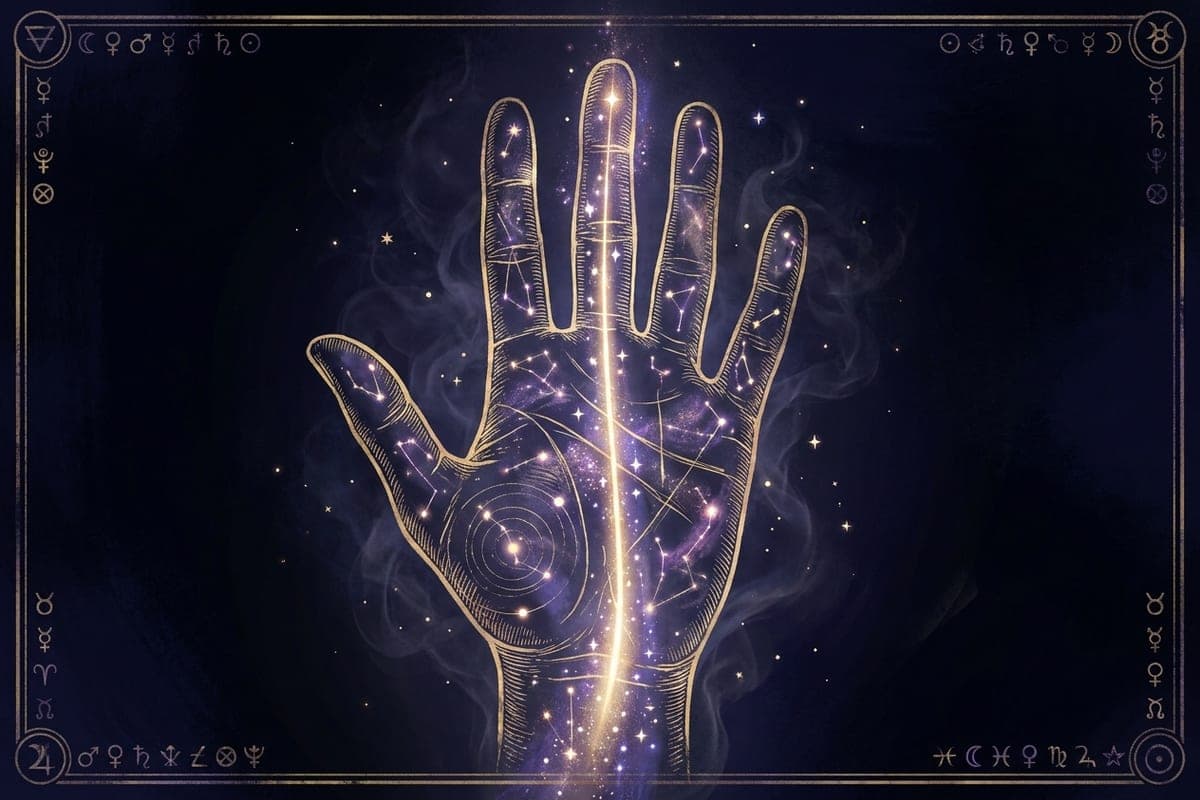
It rises from the wrist and climbs toward the middle finger, and of all the creases in a hand it is the one people most want explained. Palmistry calls it the line of fate; what it actually marks is a life's direction — and how much of that direction was ever a choice.
WHERE TO FIND IT
Hold your palm to a lamp and look for a line that runs vertically, from somewhere near the wrist toward the base of the middle finger. It crosses the horizontal lines rather than joining them. Not every hand has one, and a hand without it is not a hand without a life — it is read as a life that has not run along a single rail.
Where it begins matters more to a palmist than where it ends. Rising from the very base of the palm is read as a path set early, often by family. Rising from the mount below the thumb — the fleshy ground at the base of it — is read as a path shaped by the people who raised you. Rising out of the middle of the palm, late and clean, is read as a life that turned once and kept the turn.
WHAT A BREAK IS SAID TO MEAN
A fate line that stops and starts again is the detail that frightens people, and the tradition has never read it as an ending. It is read as a change of road: the work that was left, the city that was moved from, the plan that stopped being the plan. Two clean pieces are a life with two chapters, not a life interrupted.
An overlap — where the old line runs on for a while beside the new one — is read as a change that was prepared for. A gap with nothing in it is read as a change that arrived without asking. Palmists find more meaning in that little detail than in the length of anything.
DEEP, FAINT, DOUBLED
A deep, unwavering fate line is read as a person who has known what they were doing for a long time — which is not the same as having enjoyed it. A faint one is read as a life led by inclination rather than plan, and the tradition treats that as freedom at least as often as drift.
Two fate lines running together are read as two lives carried at once: a trade and a calling, work and the thing done after work. It is the mark palmists most often find on people who cannot answer the question of what they do for a living in one sentence.
WHAT IT DOES NOT TELL YOU
It does not tell you when anything happens. The habit of pinning ages along the line — a year per so many millimetres — is a Victorian invention with the confidence of a train timetable and none of the accuracy. A reading that names a year is inventing one.
It also says nothing about worth. A shallow fate line on a good hand is not a lesser life. Palmistry is a way of talking about a life, not a scoring of one, and any reading that starts ranking people has stopped being palmistry and started being flattery.
READING YOURS
Look at both hands. The hand you write with is read as what you have made; the other, as what you were given. A fate line that is strong on one and faint on the other is the most common thing in the world, and it is read as the difference between the road expected of you and the one you took.
Faterya will read the whole hand aloud — this line and the eight around it — from a single photograph. Take it in bright, even light, fingers apart, the whole hand in frame.
Palmistry is a way of talking about a life, not a forecast of one. Nothing here is medical, legal or financial advice.